Buried Alive (documentary)
A radical social activist vanishes, presumed dead, leaving his wife bound to a marriage she cannot escape
A radical social activist vanishes, presumed dead, leaving his wife bound to a marriage she cannot escape
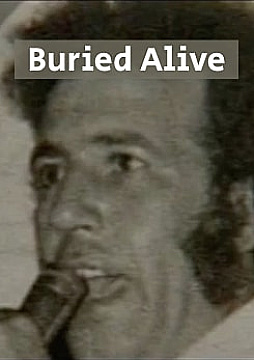
This is the story of a battle fought by a 52-year-old house cleaner who sets out to trace the footsteps of her husband, who vanished 20 years ago under political circumstances. The woman, Mazal Saiel, emerges as a fierce fighter and an unexpected heroine as she faces off against the Israeli establishment and numerous forces attempting to withhold the truth about her husband.
Danny Saiel, Mazal’s husband, was a militant activist in the "Black Panthers" in Israel, a social movement that fought in the 1970s for the rights of Mizrahi Jews (Jews of Middle Eastern and North African descent).
In 1976, Saiel fled Israel. Shortly before his disappearance, he was at the center of an arms-smuggling scandal involving Arab militants. David Ronen, former deputy head of the Shin Bet (Israel's Internal Security Agency), testifies in the film that Saiel provided explosives to Arab operatives out of ideological sympathy, after which he fled the country.
In contrast, Saiel's attorney claims that he was actually an operative working for the Shin Bet. According to this account, Saiel delivered the explosives to the Popular Front for the Liberation of Palestine (PFLP) under Shin Bet orders, and left Israel with the full approval and consent of the security services. Thus, the charges leveled against Saiel were merely part of a cover story designed to establish his credibility as an Israeli spy in Iraq. To this day, the controversy remains unresolved: Was Danny Saiel a traitor to the State of Israel, or an elite intelligence agent? His ultimate fate, whether he is dead or alive, remains unknown.
Living in deepening solitude, Mazal embarks on a journey for the first time to reconstruct her shared years with Danny and unravel the mystery of his disappearance. Following a series of encounters in Israel, France, Spain, and Germany, she becomes convinced that Israeli security forces were responsible for her husband’s assassination. In Paris, she meets Moni Yakim, an exiled Black Panther spokesperson, who reveals that a Mossad (Israel's foreign intelligence agency) agent threatened to eliminate him "just like Danny Saiel" if he didn't cease his political activities. In Madrid, Mazal searches for spiritual answers in a synagogue and scours the apartment she once shared with Danny, but finds no clues. Her trip to Germany to see Danny's brother, Ovadia, ends in disappointment, leading her down a dead end. Upon returning to Israel, she travels to the Arava desert to meet Shimon "Kushi" Rimon, Danny's cousin, a well-known colorful character with deep ties to high-ranking Mossad figures. Kushi denies any connection to the affair.
With Danny missing and no proof of his death, Mazal remains an Agunah, a "chained wife" trapped in marital limbo under Jewish law. The Chief Rabbinate (Israel's supreme Jewish judicial authority) refuses to grant her permission to remarry. Though she battles the conservative religious authorities, her faith in God remains intact; as an observant woman, she refuses to settle for a civil marriage. She demands her "passport to freedom" according to Halakha (Jewish Law).
Finally, consulting with renowned civil rights attorney Avigdor Feldman, Mazal decides to take the ultimate step: filing a petition with the High Court of Justice against the Government of Israel, the Ministry of Defense, and the Chief Rabbinate.
The film was screened at film festivals worldwide, including the Jerusalem Film Festival, the Leipzig International Festival (Germany), the FIPA Biarritz Festival (France), the Berkeley Jewish Film Festival (USA), the International Film Festival of Uruguay, and the Montreal World Film Festival (Canada).
Student or Faculty?
Watch all movies for FREE
Access through your university or college
Login through your university / college